
We often hear this question from dog owners who genuinely want to help their four-legged friends recover better. In this article, you'll learn why this is so important and how you can ensure true relaxation with a consistent recovery ritual. Because regeneration is more than just physical rest; it also includes your dog's mental calming.
Mental vs. Physical Regeneration in Dogs
Physical exhaustion is not the same as mental relaxation. After a long outing, your dog's muscles and joints may have been used, but their mind is often still in "active" mode. In our experience, many sensitive dogs of all ages, from puppies to seniors, show signs of restlessness after exercise, even if they appear tired. This can manifest as:
- Panting
- Pacing back and forth
- Constantly changing resting spots
This inner tension arises because the nervous system has not fully shut down yet.
This also means for you as a dog mom: Just because your dog looks tired doesn't automatically mean they are relaxed. Mental regeneration requires a conscious activation of the parasympathetic nervous system, the rest-and-digest nerve, which truly brings the body to recovery. If your dog doesn't find this "off switch," the restlessness persists. That's why it's important to correctly understand your dog's signals and create an environment that supports mental calm.
Source: Porges, S. W. (2011). The Polyvagal Theory: Neurophysiological Foundations of Emotions, Attachment, Communication, and Self-regulation.
Cortisol Reduction and the Effect of Lying Surfaces on Mental Recovery
After intense activity, your dog's body releases the stress hormone cortisol. This hormone keeps the dog alert and ensures short-term performance. However, for sustainable recovery, cortisol must be reduced so that the dog can transition into a relaxed state.
What we often hear: Hard or unstable lying surfaces can disrupt this cortisol reduction. If your dog lies on a surface that is too hard or an unsuitable mat, micro-pains and constant tension in muscles and joints can arise. This keeps the dog in a state of heightened alertness. As a result, your dog finds it difficult to truly unwind and relax, even if they are physically exhausted.
In our experience, an ergonomically suitable, stable, yet pressure-relieving lying surface helps your dog calm down mentally. This supports regeneration and allows cortisol levels to decrease. Especially sensitive dogs can quickly become overwhelmed if the surface is not right.
Source: Beerda, B., et al. (1998). Manifestations of chronic and acute stress in dogs. Applied Animal Behaviour Science.
The KUDDE Principle: How a Dog Bed Is More Than Just a Sleeping Place
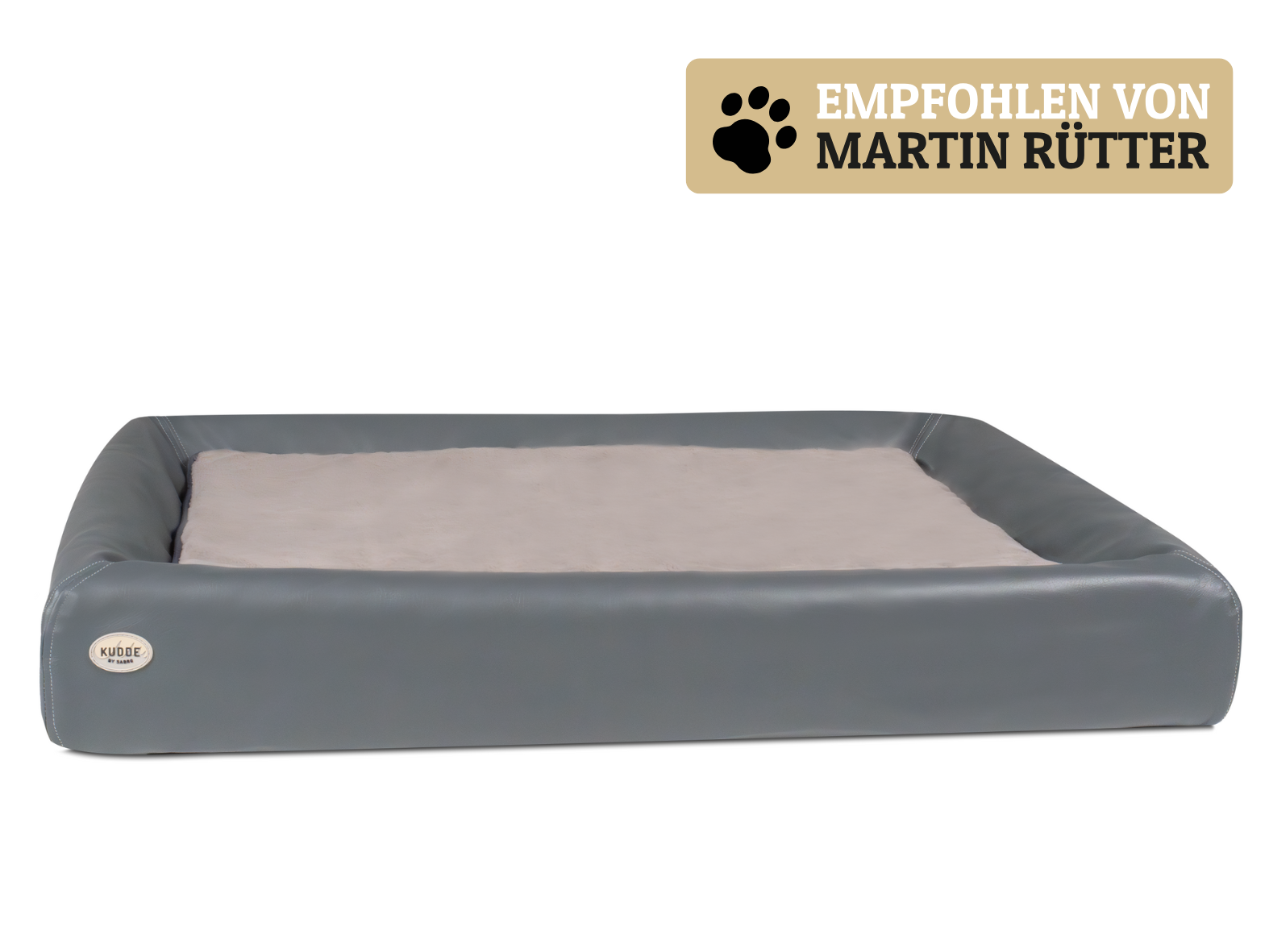
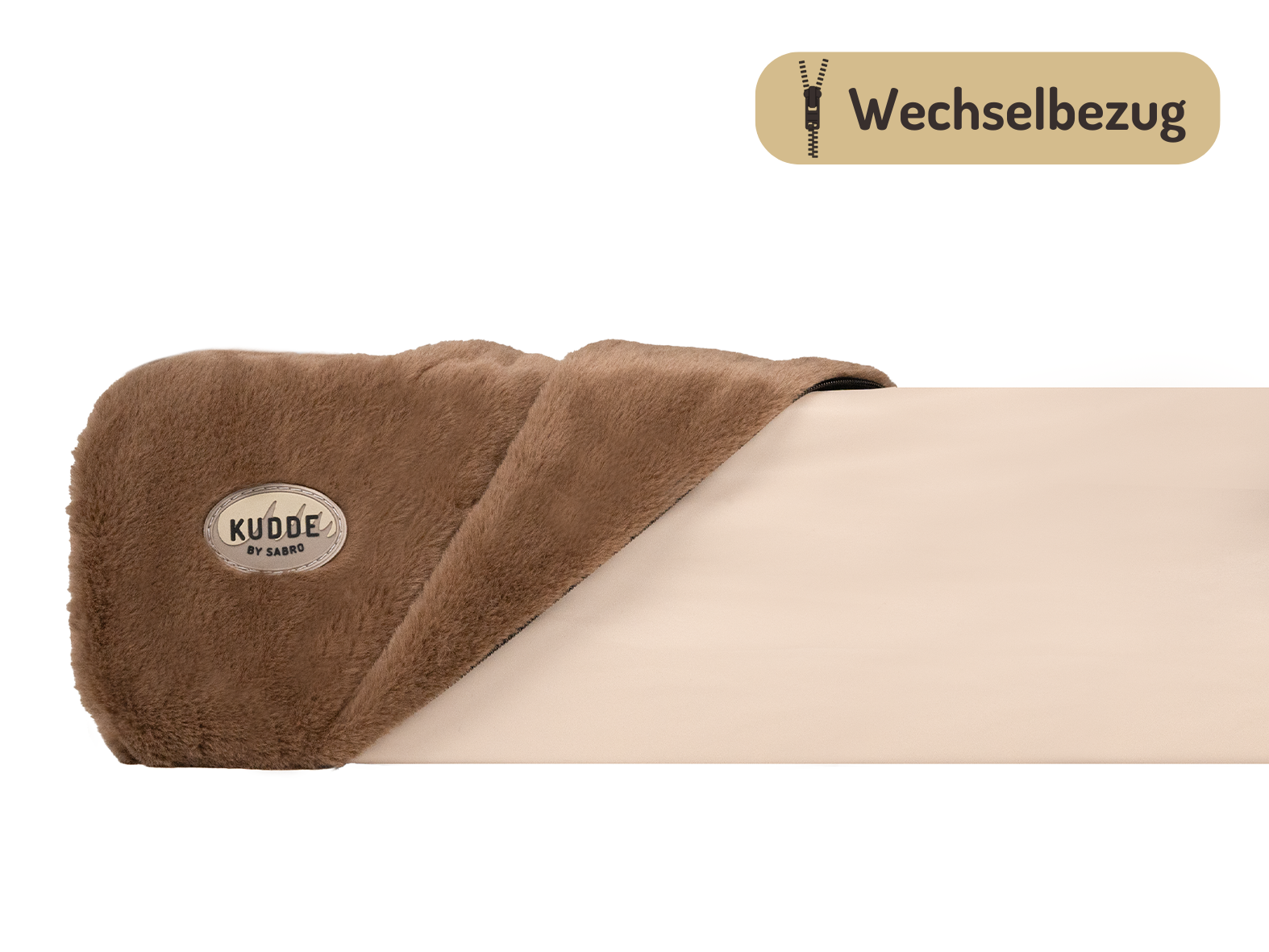
This is where the KUDDE dog bed comes in, a regeneration station. The shape-retaining rim is not just a border, but a mechanical anchor. When your dog rests their head on this stable rim, the vagus nerve is stimulated. This is a central nerve that can slow down breathing and heart rate, thus triggering inner calm. This natural calming signal helps your dog mentally switch off better.
Additionally, the orthopedic memory foam core (also called visco foam) of the KUDDE provides pressure-relieving support for joints and spine. After an active day, the joints can regenerate better. Many customers report that dogs with orthopedic problems or older animals particularly benefit from this combination. Our experience shows that younger dogs can also benefit preventatively from such a sleeping place. This creates a relaxed, protected retreat that supports not only physical but also mental well-being.
We offer a 10-year warranty on this, because during development, it was important to us to create a durable and high-quality product that benefits your dog for many years.
Source: Gerritsen, R., & Band, G. P. (2018). Breath of Life: The Respiratory Vagal Stimulation Model of Contemplative Activity. Frontiers in Human Neuroscience.
Practical Tips: How to Help Your Dog Unwind
In addition to the right lying surface, there are a few simple rituals you can incorporate. These help your dog's nervous system transition from "adventure mode" to rest mode more quickly:
- Actively model calmness: Dogs mirror our energy. If you yourself calm down right after a walk, read a book, or sit down relaxed, it signals to your dog: The action is over, there are no more expectations of him.
- Chewing or licking: Chewing on a suitable natural chew toy or licking (e.g., on a lick mat) releases endorphins and reduces stress hormones. It is one of the most natural methods for dogs to calm down internally.
- Gentle touches: Long, calm strokes on the flanks or neck can work wonders. Pay attention to your dog's reaction – some enjoy the closeness, others initially need a short time alone in their spot.
- Establish fixed resting times: Consistently lead your dog to their sleeping spot after an outing. A fixed place creates security and the certainty: "I don't have to be vigilant here anymore."
What we often hear: If your dog has a consistent recovery ritual, they can switch much more easily between activity and rest. This not only creates harmony in everyday life but also sustainably supports your dog's health, as the body gets the necessary time to complete regeneration processes fully.
Source: Overall, K. L. (2013). Manual of Clinical Behavioral Medicine for Dogs and Cats.
Conclusion
A consistent recovery ritual helps your dog to calm down not only physically but especially mentally. The KUDDE dog bed, as a regeneration station, offers ideal support for the relaxation process after active movement with its stable rim and high-quality memory foam core (visco foam). This promotes your four-legged friend's holistic recovery and creates a retreat that brings true harmony into everyday life. Feel free to try it out and discover how calm and serenity set in for your dog.
Frequently Asked Questions about Dog Regeneration
Why is my dog tired after a walk but still restless?
Your dog is physically exhausted after the outing, but their nervous system is often still tense. Mental calm takes time to set in. Uncomfortable sleeping surfaces or stress can delay this process. Give your dog a quiet environment and a suitable sleeping surface that also promotes mental relaxation.
How can I properly relax my dog after a walk?
A consistent recovery ritual helps, for example, a familiar sleeping spot with an ergonomic dog bed and a calm atmosphere. Let your dog rest their head on a stable rim to support calming via the vagus nerve. Gentle petting and soft words can also aid the relaxation process.
Why are some dog beds better for regeneration than others?
Stable, pressure-relieving materials and a shape that supports the dog while lying down are important. A rim that acts as an anchor can trigger the calming reflex. Soft, unstable, or hard surfaces often lead to micro-pains and prevent your dog from mentally switching off.
What does a consistent recovery ritual do for my dog?
Routine creates security and makes it easier for the dog to switch from activity to relaxation mode. A recovery ritual can help lower stress hormone levels and promote mental regeneration. This sustainably improves your dog's quality of life.
How does the rim of a dog bed help calm my dog?
The rim acts as a mechanical anchor where your dog can rest their head. This stimulates the vagus nerve, which slows breathing and lowers heart rate. This is a natural mechanism that triggers inner calm and serenity.
When does my dog need mental support for better regeneration?
Mental support is particularly important after intense exercise, for sensitive or older dogs, and for dogs who easily become nervous or agitated. If your dog is restless despite physical tiredness, it's a sign that mental recovery should be promoted. In our experience, suitable sleeping places and rituals can be very helpful here.